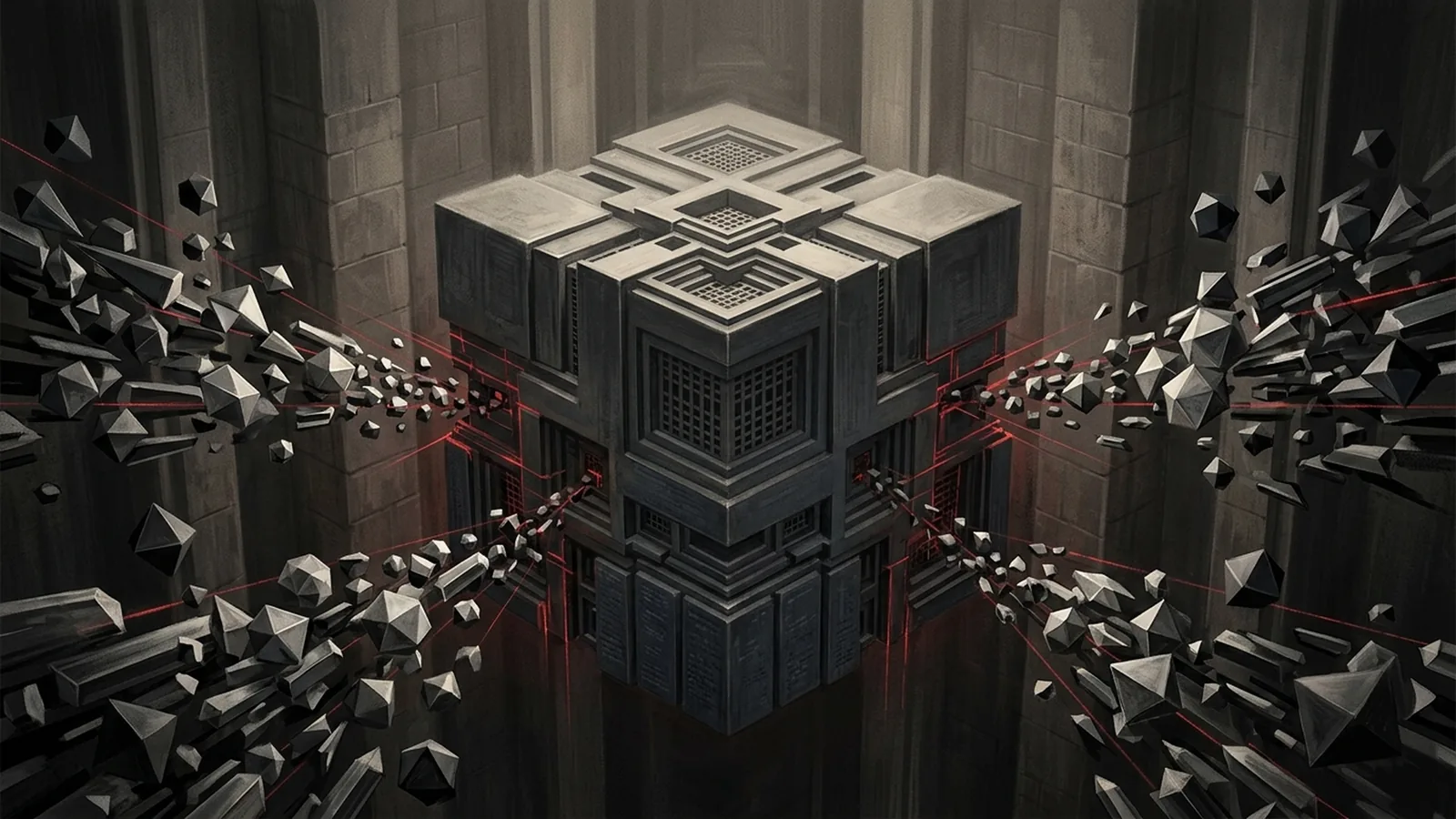
Anthropic says US officials ordered access to Fable 5 and Mythos 5 suspended for foreign nationals, so the company disabled both models for all customers. Buyers of frontier AI now have to price in a risk that sits outside the model: the state kill switch.
Fable 5 is now more than a model in incident mode. It is a sign on the data center door: the best eval can still lose to an official with a stamp and a free Friday evening.
The US government told Anthropic to restrict Fable 5 and Mythos 5 for all foreign nationals, so Anthropic switched the models off for all customers. A protest by 76 security experts exposes the weak point: export control is bad at separating an offensive exploit from defensive testing.
The state did not just take matches from an arsonist. For a moment, it took the ladder from the firefighters too, then hoped the fire would politely burn more slowly.
Research described by 404 Media says a 13 word snippet of retrieved text from sites such as Reddit, Wikipedia, Quora or Facebook can push AI agents toward spam or scam output. For AI search, that turns SEO into a prompt injection and user-generated content moderation problem.
Old SEO tried to climb over the search engine fence. The new spam sits in the library, waits for the assistant and whispers thirteen words into its ear.
Anthropic released Claude Opus 4.8 at the same standard price as Opus 4.7, with a focus on coding, agentic tasks and longer work. The more important shift is a model that is supposed to say more often when it is unsure.
Opus 4.8 is not a model meant to stun developers with one trick. It is the coworker at the whiteboard who finally pauses, points at the bad assumption and says: I would not merge this.
Nathan Lambert announced his departure from the Allen Institute for AI and used it to reflect on work around Olmo. This is not just a personnel note. It is a reminder that open models depend on institutions that must outlast one strong team.
Open AI does not win when one researcher claps at the release button. It wins when, after he leaves, the lab, the checklist and the next person still know why the data should go outside the building.
H Company released Holo3.1, a family of computer-use models for web, desktop, mobile and local inference. The important part is not only higher scores, but the attempt to move the agent closer to where the work actually happens.
Holo3.1 is an attempt to take the agent out of the data center and sit it in front of your own monitor. The real test starts when the accounting app throws a weird dialog and nobody is holding the mouse.
Latent Space frames Microsoft Build as the moment Microsoft showed its own MAI models alongside Copilot, Windows and Web IQ. The key ambition is to control data, inference and developer workflow at once, rather than leaving that leverage to partners.
Build 2026 was Microsoft's signal that it is taking the model layer back under its own roof. Copilot then stops being a wrapper for other companies' APIs and becomes a product with its own backbone.
The White House issued an executive order that calls for a classified benchmark for covered frontier models within 60 days and a voluntary framework for up to 30 days of pre-release government access. It says this is not licensing, but it creates a pressure point before launch.
The government has taken thirty days before every frontier release. Legally voluntary, but any lab with federal customers knows that refusing will be more complicated than joining.
Uber is limiting monthly token spend to $1,500 per employee for each agentic coding tool, according to Bloomberg via Simon Willison. Coding agents are becoming a budget line item.
Coding agents just reached the first cashier window. The winning team will not burn the most tokens, it will tie the agent bill to a specific merge.
Latent Space's interview with Andon Labs shows evals that look less like exams and more like running a small business. The key ingredients are long horizons and real consequences.
Andon shows the agent something harder than a test: an open shop, a customer at the counter and a bill someone has to pay. In that scene, capability and failure stop hiding behind a score.
Google introduced an agentic RAG system for Gemini Enterprise Agent Platform that checks whether it has enough context before answering. For companies, that brake matters more than another polished retrieval layer.
The value of the system does not rest on the number of agents in the architecture. It rests on whether an answer has a readable trail back to the source, or ends up as confident text with no address.
Simon Willison released the alpha package micropython-wasm and a Datasette Agent plugin that runs Python inside a WebAssembly sandbox. The important part is not the demo, but the boundary between a useful agent and code that can break its host application.
An agent that can run code without a sandbox is not a colleague. It is an intern with root access and a curious finger hovering over delete.
Latent Space published Auriel W's piece on why low-quality RL environments damage agent training. The point is simple: in reinforcement learning, the environment is the data generator, so a harness bug becomes training material.
A broken RL harness is not a bad lab. It is a teacher who writes the wrong lesson on the board every morning and then acts surprised when the model repeats it.
Sebastian Raschka published a curated list of LLM papers from January to May 2026. It is a useful filter for teams trying to separate the research feed from topics that matter for architecture, agents and inference.
Raschka did not build this for anyone to swallow whole. It is a map on the wall: the pins show directions, but every team still has to get its own shoes dirty on the way to proof.