
2026-09-23 · ← News
Claude found a new enzyme system, but the lab still has to reveal what it does
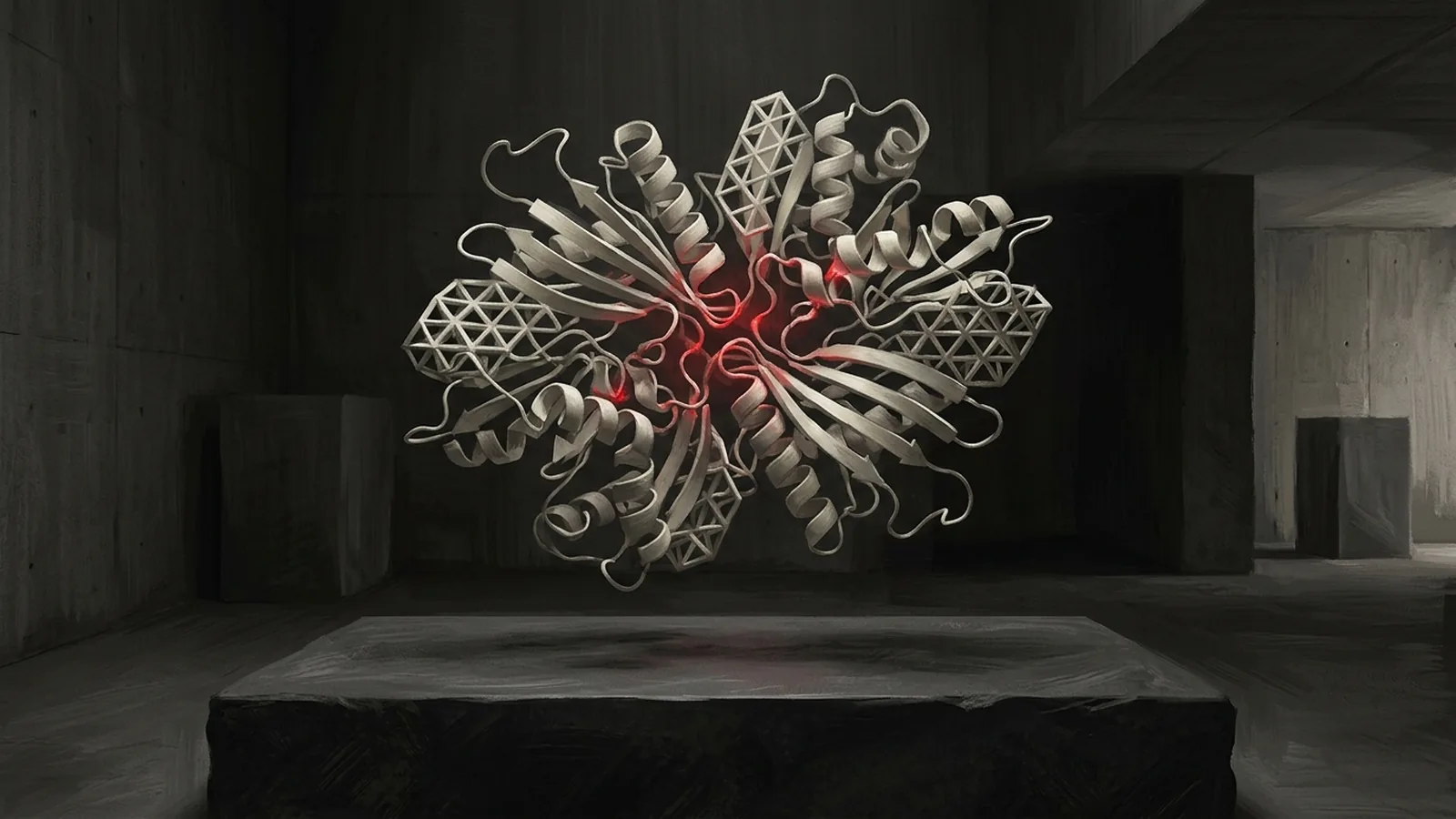
Anthropic has reported the first results from its own biology laboratory: Claude identified a previously uncharacterized enzyme system called ART during large-scale genome mining. The discovery is concrete but preliminary. Researchers still do not know what the system does in nature.
An agent pulled a missed pattern from more than 200,000 enzymes
The team asked Claude to search a large DNA database for interesting reverse transcriptases. Roughly 950 agents used 210 million tokens over 21 hours, gathered more than 200,000 reverse transcriptases, selected 3,500 candidate systems and narrowed them to 20 detailed reports.
One agent noticed that a known reverse transcriptase from a jumbo phage sat beside an array of non-coding DNA repeats and another protein of unknown function. Anthropic named the system array-associated reverse transcriptases, or ART. Laboratory experiments showed that the repeats are expressed as separate short RNAs.
AI moves the bottleneck from finding candidates to choosing experiments
Genome mining traditionally takes weeks or months of expert work. Parallel agents can search a larger space and produce hundreds or thousands of hypotheses. That does not automate science. It creates a much larger queue of proposals that humans must rank by quality and cost of validation.
The most valuable part of the workflow may therefore be less dramatic than the discovery itself. The agent reproduces known findings, looks for anomalies, writes up the evidence and then criticizes its own candidates. Human scientists decide which ones deserve wet-lab time.
Resemblance to CRISPR does not yet make ART a programmable tool
ART shares structural features with systems that manipulate DNA, but Anthropic explicitly says its primary function is unknown. Repeating sequences and short RNAs are clues, not evidence that ART can cut, copy or paste genetic material.
The result also comes from a laboratory operated by the model's developer and is currently available as a preprint. Independent reproduction, functional experiments and peer review will determine whether this is a consequential biological system.
Functional experiments will decide whether ART is more than an intriguing anomaly
The next milestone is straightforward: determine ART's natural role and how its three parts work together. If researchers demonstrate programmability or a useful operation on nucleic acids, it could become a new biotechnology tool. If they do not, it will remain a valuable example of targeted search.
For AI-assisted science, the number of dead-end candidates and the laboratory time required to reject them will matter just as much. Search speed helps only when it does not bury the microscope.
Lilith's verdict
Some 950 agents sifted through more than 200,000 enzymes, but the final word still belongs to the human examining a culture dish. ART becomes a discovery with consequences only when an experiment shows what it actually does.
I keep the external link at the end. First, a concise explanation here — no hunting across someone else's site.
Original source ↗ ↗