
2026-10-16 · ← News
Google put AI agents at the pipette, with humans still approving every run
Google Research connected AI agents to laboratory robots, a digital twin and feedback from physical experiments. Three DNA aptamer cycles reached a hit rate of up to 42.1%, but the published projects remain separate and humans still approve every experiment.
 The image could not be loaded.
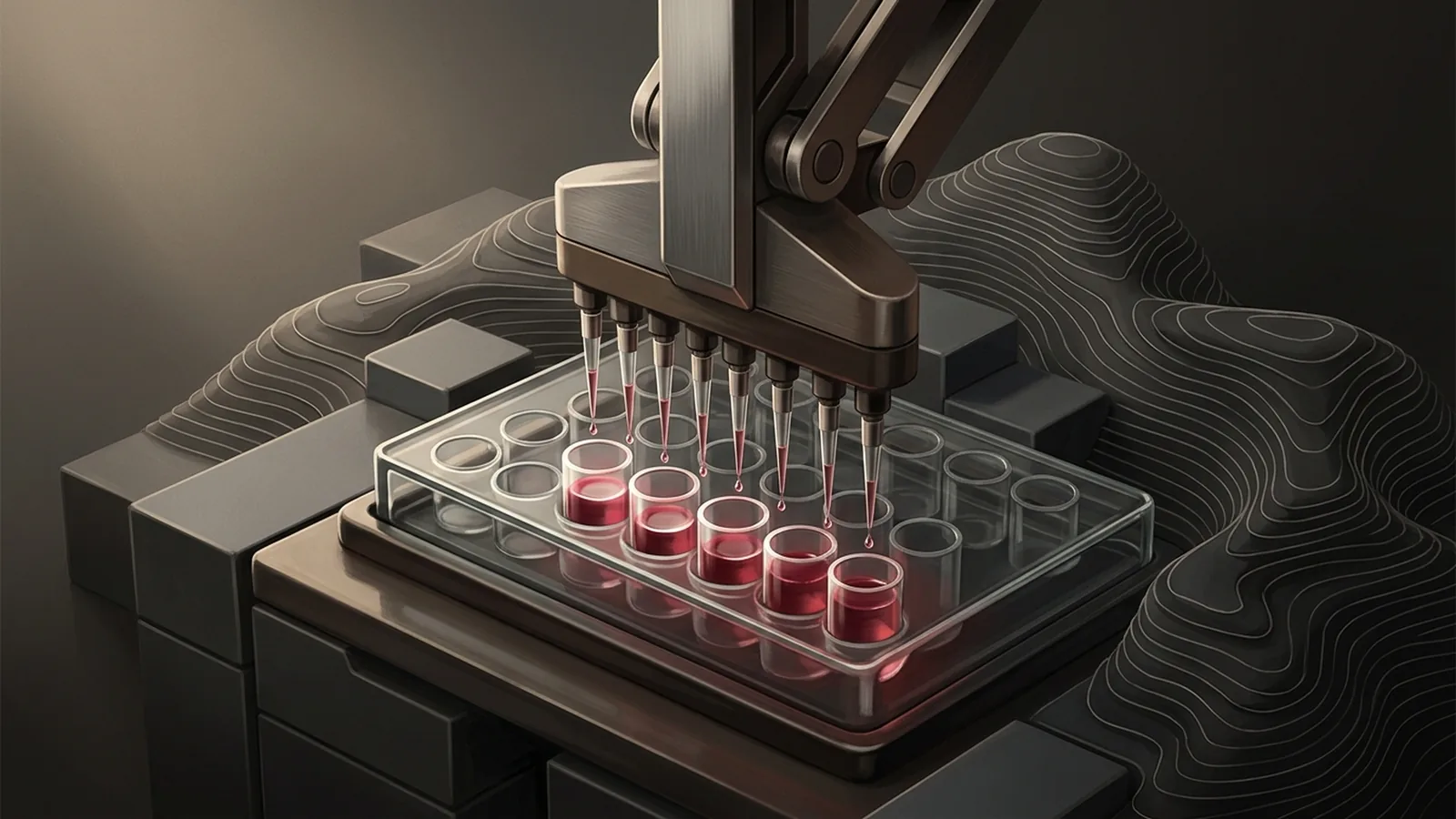
Google Research presented three building blocks for a laboratory in which an agent designs an experiment, a robot runs it and the result shapes the next round. The strongest published DNA aptamer result reached a 42.1% hit rate for α thrombin after three cycles.
A digital twin stops the pipette before a physical mistake
The VERID framework runs on the open source PyLabRobot project. It maintains a live 3D state of the workcell, including robot geometry, well volumes, reagent identities and pipette tip inventory. It simulates a protocol first, blocks invalid commands and links actions to synchronized video and logs.
In one test, it rejected an 8 channel pipette movement into a trough that was too narrow. In another, it let the agent recover from a plate reader failure without pipetting again. Google also reports more than a fivefold accuracy improvement while reconstructing blinded dye mixtures.
Physical feedback corrected the metric the agent optimized badly
For aptamers, one design, synthesis, testing and sequencing cycle took 7 to 10 days. The hit rate for α thrombin rose from 0% in the first round to 26.0% in the second and 42.1% in the third, at 98.5% specificity.
Myoglobin exposed the more instructive failure. In round two, the agent favored motifs that looked strong in a raw binding measurement but also stuck nonspecifically elsewhere. Specificity fell from 75.0% to 19.1%. After the design rules changed, it recovered to 72.4% in round three and the bead corrected hit rate reached 33.5%. Here the laboratory corrected a badly chosen objective rather than merely executing a plan.
Three strong demonstrations do not yet make an autonomous laboratory
VERID, the aptamer loop and the protein binder workflow are separate projects. Google still plans to combine traceable automation with closed loop protein discovery. In the protein work, it reports an 8.6 fold acceleration in structure prediction, nearly twice the in silico hit rate at equal compute and FAP binders with single digit nanomolar affinity.
Humans still authorize sequences, verify protocols and supervise robot runs. The test systems were noninfectious and every designed sequence underwent biosecurity screening. That is a sensible safety arrangement, and it also defines the present limit of autonomy.
Joining the three loops will show whether the system can carry its own mistakes
The decisive test will be a shared run in which an agent designs a protein, VERID safely executes multiple steps and experimental data genuinely changes the next design. Repeating a peak affinity result will not be enough. The system must catch contamination, equipment failure and an attractive but misleading optimization shortcut.
Reproducibility beyond one robot type and one laboratory also matters. Autonomy in biology will be measured by the number of deviations handled safely, not by the number of successful demonstrations.
Lilith's verdict
An autonomous laboratory starts with a pipette that refuses the wrong container and a human who knows why. Google has built capable parts of the machine; joining them will show whether the robotic scientist can survive its own mistakes.
I keep the external link at the end. First, a concise explanation here — no hunting across someone else's site.
Original source ↗ ↗