
2026-11-06 · ← News
ToyBlocks gives robot learning a controlled laboratory, with a 5.5-point sim-to-real gap
Ai2 released the open ToyBlocks simulation with 85,336 demonstrations and nearly 1,600 hours of robot data. Its hierarchical system scored 55.5% in simulation and 50% on a physical robot, although only in the easiest scene configuration.
 The image could not be loaded.
Ai2 has released ToyBlocks, an open environment for training and measuring robotic systems, with 85,336 long-horizon demonstrations and nearly 1,600 hours of data. Its value is not the blocks themselves. It lets researchers vary one condition at a time and trace why a robot failed.
ToyBlocks joins data generation, training and evaluation in one world
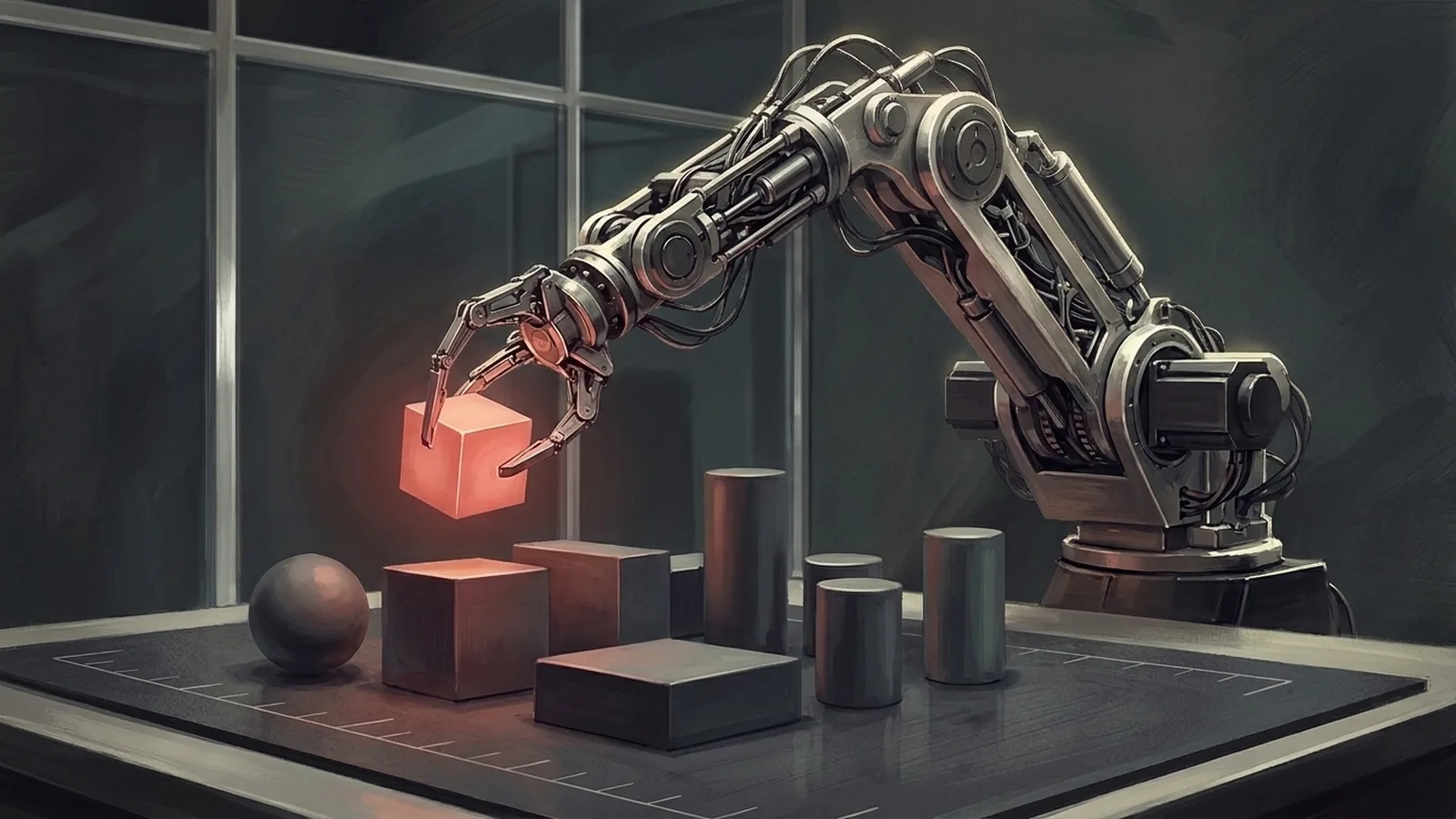
The environment contains a robot arm and blocks marked with letters and images. It generates tasks and demonstrations automatically, running hundreds of plans in parallel on one GPU at up to 24 times real time. Researchers can vary block size, table height, lighting and object positions while separating high-level planning from low-level execution.
The first release includes simulation assets, task generators, training and evaluation code, plus Molmo 2 and ManiFlow models. Its dataset contains 144 million frames. Ai2 targets a larger second release within weeks, but that material is not in the current package.
A controlled world separates a bad plan from a bad hand
Typical robot demos show an outcome without isolating its cause. ToyBlocks supplies high-level and low-level oracles, allowing teams to distinguish choosing the wrong block from executing the right plan badly.
In one experiment, an agent raised success from 24% to 63% after running tests and writing its own tool descriptions. Human-written descriptions reached 36%. That supports environment learning in this narrow setting, not a claim of general robotic intelligence.
Physical transfer worked inside a deliberately narrow slice
ManiFlow’s atomic skills scored 80.0% in simulation and 81.1% in reality. The Molmo 2 plus ManiFlow hierarchy completed 111 of 200 simulated episodes and 15 of 30 physical ones, or 55.5% and 50.0%. The physical test used the easiest scene, visible upright characters and only 30 episodes.
Blocks are intentionally a small world. Control improves diagnosis while limiting conclusions about warehouses, homes and unfamiliar objects. The authors correctly call for more trials before treating the real-world result as statistically firm.
Replication will separate a benchmark from a showcase
The strongest signal will be independent teams reproducing the validations and building data mixtures that change performance predictably. Open code gives that scrutiny a better foundation than a closed robot demo.
The second test is harder physics: two arms, touch sensors and unstructured piles. If causal diagnosis survives there, FoundationWorlds could provide what robotics benchmarks often lack: an experiment that can point to the component responsible for failure.
Lilith's verdict
A stage demo can hide a flipped block behind the robot. ToyBlocks leaves it under the camera and makes the researcher explain which part of the system knocked it over.